
Whether you’re at a lively table with friends or playing online from home, poker rewards clear thinking and good judgment. At its core, success often comes down to recognising card combinations—known as "combos"—and understanding which hands matter most in a showdown.
If you’ve wondered why some players act quickly to bet, fold, or raise, it’s not mysterious. Knowing your combos gives you a measurable edge and helps you make better decisions as the cards are revealed.
Get ready to unravel how poker hands form and what they mean in play. By the end of this guide, you’ll have a clearer sense of how combinations shape the game, whether you’re a curious beginner or brushing up on the basics.
What Are Poker Combos?
In poker, the word "combo" is short for "combination." It describes the different ways you can make a specific hand from the cards available.
A combo isn’t a trick; it’s simply a particular mix of cards. For example, an Ace of hearts and King of spades is one combo, while Ace of hearts and King of clubs is another. Both can produce the same type of hand, but they are counted separately when analysing probabilities.
Combos matter because they let players estimate what opponents might have and how many ways a given hand could be formed from the remaining cards. That information helps shape decisions about betting and timing.
How Do Poker Combinations Differ From Poker Hands?
These terms are related but distinct. A "poker combination" refers to the specific arrangements of cards that can make a hand, while a "poker hand" is the final ranked set of five cards used at showdown—examples include a straight or a full house.
Thinking in combos is analytical: you count the specific two-card or five-card configurations that could lead to a hand. Thinking in hands focuses on the ranking and how that ranking beats other hands at the table. Both views are useful: combinations feed into understanding the likelihood of particular hands, and hand ranks determine the outcome when players reveal their cards.
Understanding the Basic Poker Hands
Below are the standard poker hand rankings, listed from highest to lowest, with a short note on each to help you recognise them at the table.
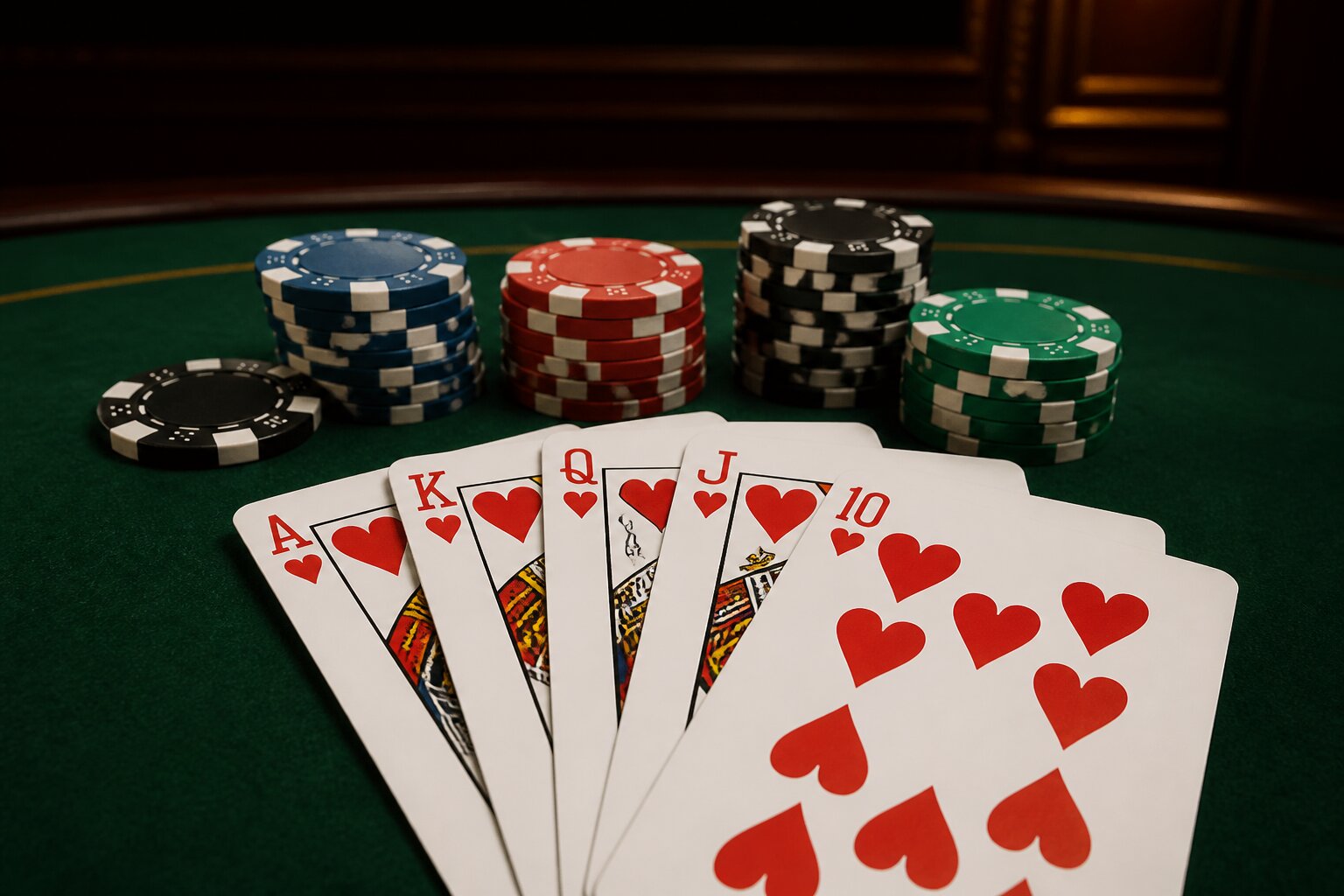
Royal Flush
Ace, King, Queen, Jack and Ten, all of the same suit. This is the top-ranked hand and cannot be beaten by any other hand except another identical royal flush, in which case the pot is shared.
A royal flush is a specific type of straight flush that uses the highest possible cards.
Straight Flush
Five consecutive cards of the same suit that are not the royal sequence. For example, 9-8-7-6-5 of hearts is a straight flush.
When two players have straight flushes, the one with the highest top card wins.
Four of a Kind
Four cards of the same rank, such as four 8s, plus one unrelated card known as the kicker. The kicker can decide the winner if two players both hold four of a kind.
Four of a kind is sometimes called quads.
Full House
Three cards of one rank and two cards of another, for example, three Kings and two Jacks. The rank of the three-card set determines which full house is higher.
If two players have full houses, the one with the higher three of a kind wins.
Flush
Any five cards of the same suit that are not in sequence. For instance, Ace-10-7-4-2 of clubs is a flush.
If two players both have a flush, the highest card in each flush is compared, then the next highest if needed, and so on.
Straight
Five cards in numerical sequence, but not all the same suit. An example is 7-6-5-4-3 of mixed suits.
A straight with an Ace can count as the highest (Ace-high) or lowest (Five-high), depending on the sequence.
Three of a Kind
Three cards of the same rank, plus two unrelated side cards, often called kickers. For example, three Queens with a 9 and a 4.
When comparing, the three-card rank is the first decider, then the kickers if necessary.
Two Pair
Two different pairs, such as two 4s and two 9s, plus one side card. The higher pair determines the stronger two pair hand.
If the highest pairs are equal, the second pair is compared, and if still equal, the side card decides.
One Pair
Two cards of the same rank, with three unrelated side cards. For example, a pair of Jacks with a King, 8 and 3.
When two players have a pair, the higher pair wins; kickers are used if pairs are the same rank.
High Card
When no other hand is made, the highest single card determines the hand’s value. For example, Ace-high beats King-high.
If players share the same highest card, the next highest cards are compared in turn until a winner is found.
How Are Poker Hand Rankings Determined?
Hand rankings reflect how often each configuration appears from a standard 52-card deck. Rarer hands rank higher because they are less likely to be formed in play. That basic principle is why a royal flush sits above a straight, and a straight sits above three of a kind.
For example, a royal flush is exceptionally rare compared with a high-card outcome, so it sits at the top. Players use these rankings at showdown to determine the winner. When two or more players have the same type of hand, ties are settled by comparing the relevant side cards or kickers.
Common tie-break situations include:
- When two players hold the same pair, the highest remaining cards decide the winner.
- When two players have the same two pair, the fifth card, or kicker, determines the outcome.
- When straights or flushes are the same, the highest card in the combination wins.
Understanding the relative rarity of hands helps you interpret the strength of your own cards and the potential range of opponents’ hands without overcomplicating decisions. It can guide whether you call, raise or fold, while keeping focus on sensible, risk-aware play.
How Many Possible Poker Hand Combinations Exist?
A standard 52-card deck yields 2,598,960 distinct five-card hands, calculated by the combination formula C(52, 5). That large total is the basis for all probability estimates in five-card poker, and it lets you compare how likely different patterns are to occur.
Different hand types occupy very different portions of that total. For example, a royal flush represents only four possible hands out of the 2.6 million, while high-card combinations account for well over a million hands. Other ranks fall between those extremes, with some being uncommon but not impossible and others appearing fairly regularly in play.
Those numbers give concrete context to phrases like "rare" and "common" when discussing hands. They do not imply certainty; instead, they show the relative frequency of outcomes you might face during a session. Even rare hands can appear more often than expected in the short term because of variance, while common hands may sometimes seem scarce in a single session.
Keep in mind that these frequencies describe theoretical probabilities in a fair, shuffled deck and are useful for understanding long-run expectations. They are not guarantees of short-term results, and play should always be approached responsibly.
Why Do Combos Matter in Poker?
Combos give structure to uncertainty. By counting the possible ways a hand can be formed, you get a clearer picture of what opponents might hold and which hands remain likely as the board develops. That makes it easier to prioritise which lines of play are sensible and which are speculative.
That insight supports more measured choices about:
- betting size,
- continuation bets,
- folding decisions.
Put another way: combos translate the visible cards into a set of plausible hidden hands. That helps you assess risk and reward while keeping play aligned with the information the table provides. Over time, using combos consistently will improve how you read situations and reduce reliance on guesswork.
Common Beginner Myths About Poker Combos
Here are some misconceptions that often slow new players down, with concise corrections.
Myth 1: "If I know combos, I’ll win more often."
Knowing combos improves your decision-making and will often lead to better plays. However, it does not guarantee a win every session. Poker still involves opponents making mistakes and variance playing a large role. Think of combos as a tool that increases the quality of your choices rather than a certainty of profit.
Myth 2: "Some combos are due to hit."
Each deal is an independent event. Past outcomes do not force particular future cards to appear. Even if only a few combos remain that complete a draw, that does not make them any more likely on the next card because each card is drawn fresh from the remaining deck.
Myth 3: "Combos can beat variance."
Combos help you manage the game’s variability by informing risk, but they do not remove the game’s inherent unpredictability. Using combo knowledge allows you to make +EV decisions and control losses, yet stretches of bad luck can still occur. The best practical use of combos is to improve long-term results through consistent, well-founded decisions.
These clarifications can keep expectations realistic while you improve. Remember that steady progress in understanding combos compounds over time and leads to better strategic choices.
Poker Combo Examples in Practice
Practical examples make the idea of combos easier to grasp.
If you are dealt Ace of hearts and Ace of diamonds, that specific pair is one combo. Another player holding Ace of spades and Ace of clubs is a different combo—even though both players have pocket aces. For pocket pairs there are six distinct two-card combos using four matching ranks in the deck.
On a board showing Queen of clubs, Ten of hearts and King of diamonds, an Ace and Jack in hand create a ten-to-ace straight sequence. Different suit combinations of Ace and Jack produce multiple two-card combos that can lead to the same completed straight. Counting those options helps you estimate how many players might be able to make that hand.
These examples show how identical hand rankings can arise from different underlying card combinations, and why counting those combos aids in reading the table.
Essential Poker Terminology You Need to Know
A few terms commonly used with combos and hands will make table talk and analysis simpler. Learning them will help you follow action, assess situations and discuss hands more clearly with other players.
Combo (Combination)
A specific way cards can be combined to form a hand. Combos are useful when counting how many possible hands an opponent can have, for example when estimating ranges.
Outs
Cards in the deck that will improve a currently incomplete hand to a target holding. Knowing your outs helps you work out your chances of completing a draw and whether it is profitable to continue.
Pocket Cards (Hole Cards)
The private cards dealt to each player in games like Texas Hold’em. These are only visible to you and, together with the board, determine your final hand.
Board
The community cards dealt face-up that all players use alongside their hole cards. The board changes across betting rounds, and each new card can dramatically alter the strength of hands.
Kicker
A side card that resolves ties when players hold the same ranked hand. Kickers often decide close pots, so it is important to consider them when comparing hands and planning bets.
Draw
A hand that can improve to a stronger hand if the right card(s) appear on later streets. Common draws include straight draws and flush draws, and knowing how to play them depends on outs, pot odds and position.
Knowing these terms helps you translate what you see into practical judgments during a hand. Use them to structure your thinking about ranges, odds and decisions at the table.
Frequently Asked Questions About Poker Combos
Here are clear answers to questions players commonly ask, presented to help you decide what to focus on next.
What are poker combos, in simple terms?
They are the different specific card arrangements that make up a particular hand.
How do combos help during a poker game?
They let you assess which hands are possible given the visible cards, supporting more informed decisions about betting and folding.
Are combos important for beginners?
Yes. Learning combos gives beginners a better grasp of the game’s structure and improves hand reading without requiring advanced mathematics.
Does knowing combos mean I’ll win more often?
Understanding combos improves decision quality, but it does not guarantee success. Use that understanding to make thoughtful choices and manage risk.
Where can I get help if gambling stops being fun?
If poker or gambling begins to cause concern, support organisations such as Be Gamble Aware and GamCare can provide guidance and resources.
Keep building your knowledge at a steady pace, apply what you learn at the table, and enjoy the challenge of improving your game.
**The information provided in this blog is intended for educational purposes and should not be construed as betting advice or a guarantee of success. Always gamble responsibly.