
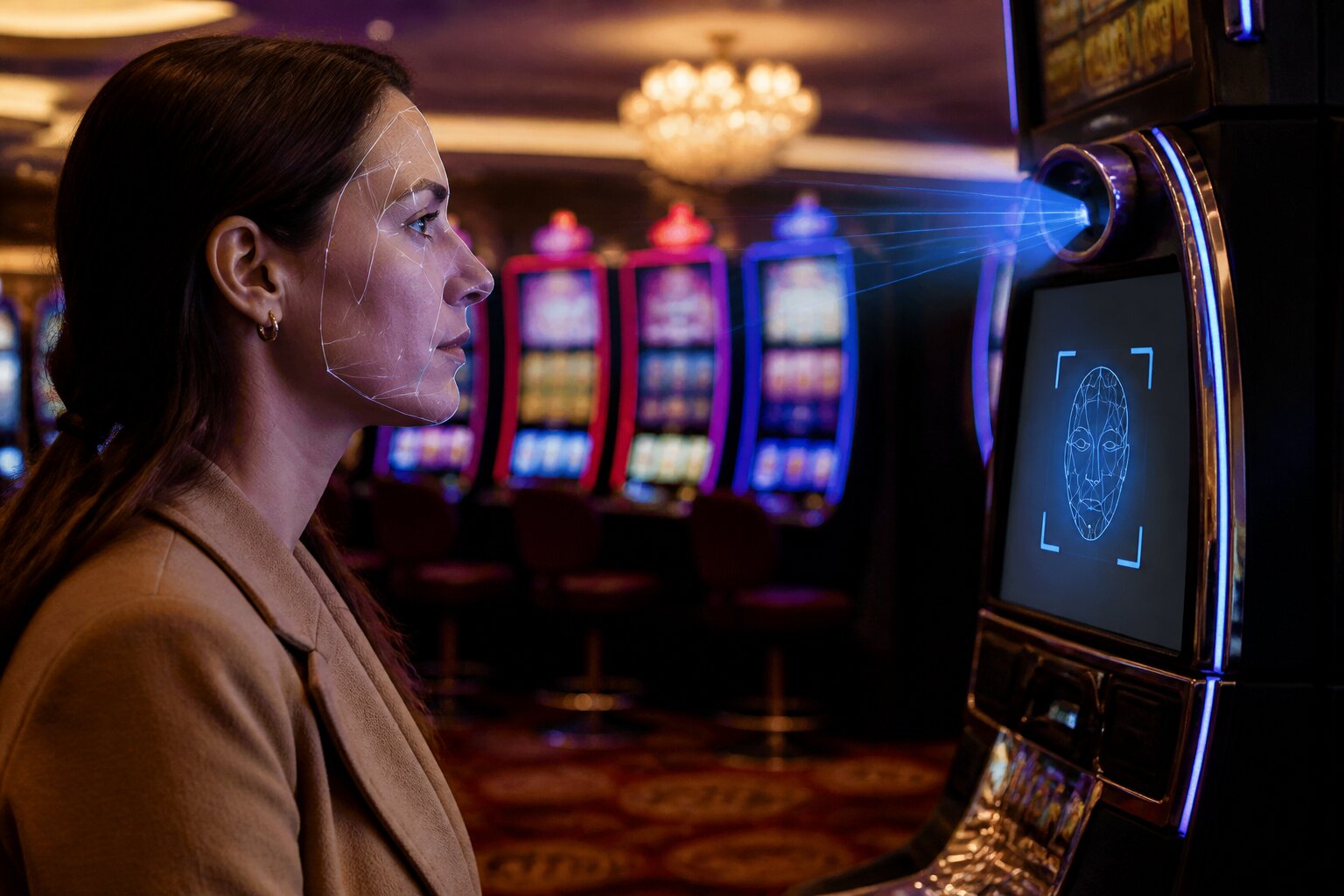
Ever sat at a slot machine and wondered just how much it knows about you? With technology getting smarter by the day, it's only natural to question what’s happening behind those spinning reels.
From cashless payments to personalised experiences, the world of slots in the UK is evolving rapidly. As venues adopt new tools to enhance security and customer care, concerns about privacy have grown too—rumours about cameras and face-scanning tech can leave players uneasy.
The idea of a slot machine recognising your face sounds like something from a futuristic film, yet there is a real conversation about whether such technology is in use in British casinos and what it might mean for everyday visitors. Let’s look at what’s actually happening on the casino floor and how surveillance measures are applied.
What Is Facial Recognition Technology in Casinos?
Facial recognition in a casino context uses cameras to capture images of faces and turn those images into biometric templates. These templates are digital representations of facial features that can be matched against stored records to identify someone.
Cameras around a venue capture people as they enter or move about the floor. Software measures aspects like the spacing of facial features and converts that into encrypted data. The main purpose for deploying such systems in the UK is security-related: preventing crime, supporting self-exclusion schemes, and protecting vulnerable customers. Where used, the technology is intended to help staff spot individuals who have requested exclusion or those who pose a security risk, allowing staff to intervene appropriately.
Any deployment is subject to strict legal and regulatory oversight. Operators must justify the use of biometric processing, show that handling of data is proportionate, and meet data protection law requirements set out in law and by the gambling regulator. That legal framework is designed to make sure personal information is handled securely and only for clearly stated reasons. This context will help explain why facial recognition is rarely embedded directly into gaming machines themselves.
Are Slot Machines Using Facial Recognition for Security Purposes?
Slot machines in the UK are not fitted with facial recognition technology as part of the individual device. Security implementations tend to be centralised: cameras and processing are managed at venue or building level rather than by each machine. This means the gaming device itself remains standard hardware with no embedded face-scanning module.
Some venues trial facial recognition systems at entrances or in public areas to help with self-exclusion enforcement and crime prevention. Those systems are managed centrally, and any match or alert is handled by authorised staff following clearly defined procedures. Widespread installation of facial recognition on every machine would present significant privacy and regulatory hurdles, which is one reason the industry has focused on targeted, venue-level solutions instead.
The regulatory framework requires that any such system be used only for legitimate safety or legal purposes, and that customers are properly informed. With that in mind, many operators continue to rely primarily on a combination of trained security personnel, robust CCTV networks, and identity checks to protect customers and comply with their licence conditions. The practical effect is a security architecture that keeps biometric processing separate from the operation and outcomes of gaming machines.
Before we explore how this impacts privacy in more detail, it helps to understand how data protection law shapes what venues can do with facial data.
How Does Facial Recognition Affect Player Privacy?
Facial recognition raises several privacy concerns because images and biometric templates are sensitive personal data under data protection law. That classification places heavier obligations on operators in terms of lawful basis, transparency, storage and access.
Operators must have a clear, proportionate purpose for processing biometric data, such as enforcing a self-exclusion request or preventing known offenders from entering. They must also carry out data protection impact assessments that describe risks and mitigation. Notices and signage should explain that certain areas may be monitored and how the information will be used. Where biometric processing is in place, customers have specific rights: to request copies of their data, ask for inaccuracies to be corrected, and in some cases ask for deletion when the data is no longer necessary.
Practical questions often include how long images are kept and who can view them. Typical policies limit retention to the minimum needed for the stated purpose; for example, live facial templates used solely to flag a self-exclusion match are usually retained only for as long as the underlying exclusion remains in force or for a legally justifiable period. Access is typically restricted to named staff and logged to provide an audit trail. If a customer believes their rights have been breached, they can complain to the operator and, if unresolved, raise the matter with the Information Commissioner’s Office.
Understanding these rights and safeguards clarifies what customers should expect. Next, we look at the technical and operational protections that make secure handling possible.
Is Data Collected from Slot Machine Facial Recognition Secure?
When venues do process facial data, they must protect it to a high standard. Legal obligations require strong technical and organisational measures to prevent unauthorised access, misuse or accidental loss.
Encryption is commonly used for both storage and transmission so images and biometric data templates are not readable if intercepted. Systems are configured with strict role-based access controls and activity logging so only authorised staff with a legitimate reason can view matches or review footage. Regular audits, vulnerability assessments and third-party testing help ensure systems remain secure against cyber threats.
Policies also set out retention limits and procedures for securely deleting data when it is no longer needed. Operational safeguards include training frontline staff in privacy-aware procedures and ensuring any alerts generated by biometric systems are acted on in a manner that respects dignity and legal rights. Regulators can inspect these controls and impose penalties for non-compliance, so there is a practical incentive for venues to maintain robust protection measures.
With security and governance in place, venues aim to balance the benefits of detection and prevention with individuals’ right to privacy. The next section clears up some common misunderstandings that arise around this technology.
Common Myths About Slot Machine Facial Recognition
Rumours and misconceptions tend to appear fast when technology intersects with public spaces. The following points address two frequent misunderstandings about facial recognition around slot machines.
Are Casinos Secretly Spying on Players?
There is a perception that operators might be covertly monitoring players using facial recognition. In practice, covert or undisclosed processing of biometric data is not compatible with UK data protection requirements. Venues must be transparent about monitoring that involves biometric processing and put in place lawful grounds for it. Signage and privacy notices are expected where such systems operate, and covert use would expose operators to regulatory action. This should reassure customers that cameras and analytics are subject to legal tests and oversight, rather than being used without accountability.
Can Facial Recognition Influence Wins or Losses?
Another persistent myth is that facial recognition could somehow be used to alter gaming outcomes. The outcome of a slot spin is governed by certified random number generation processes and regulatory oversight. Surveillance systems and biometric processing are separate functions and have no technical link to how games determine results. Any attempt to use personal identification to influence game behaviour would contravene licence conditions and lead to significant regulatory consequences.
Clearing up these myths helps focus the debate on real policy questions and practical protections. Finally, let us consider how the future might unfold.
Future Trends: Will Facial Recognition Become Standard in UK Slot Machines?
Widespread installation of facial recognition on individual slot machines looks unlikely in the near term. Current industry activity concentrates on targeted applications at entrances or public areas where the technology can support self-exclusion and crime prevention without embedding biometric processing into every device.
Any broader rollout would need to demonstrate clear public benefit and meet strict tests around necessity, proportionality and privacy. That means convincing regulators and the public that the advantages outweigh the intrusion and that robust safeguards are in place. Developments are more likely to favour improved identity checks at entry, better integration between self-exclusion schemes and venue systems, and enhancements to venue-wide security infrastructure.
Technology and regulation will continue to shape the landscape, but the priority for operators and regulators alike will remain protecting customers and their personal data. With that balance in mind, venues are expected to proceed cautiously, and changes will be closely scrutinised to ensure they serve legitimate safety objectives while preserving privacy.
Play Online Slots at Daisy Slots
We’d love to welcome you to our site, where it is all about enjoying your experience at your own pace. Discover a friendly place to play and have some fun with us.
If you fancy joining in, creating an account and making a deposit is a straightforward process. We’re here to make sure your time with us is enjoyable from the moment you start playing.
**The information provided in this blog is intended for educational purposes and should not be construed as betting advice or a guarantee of success. Always gamble responsibly.