
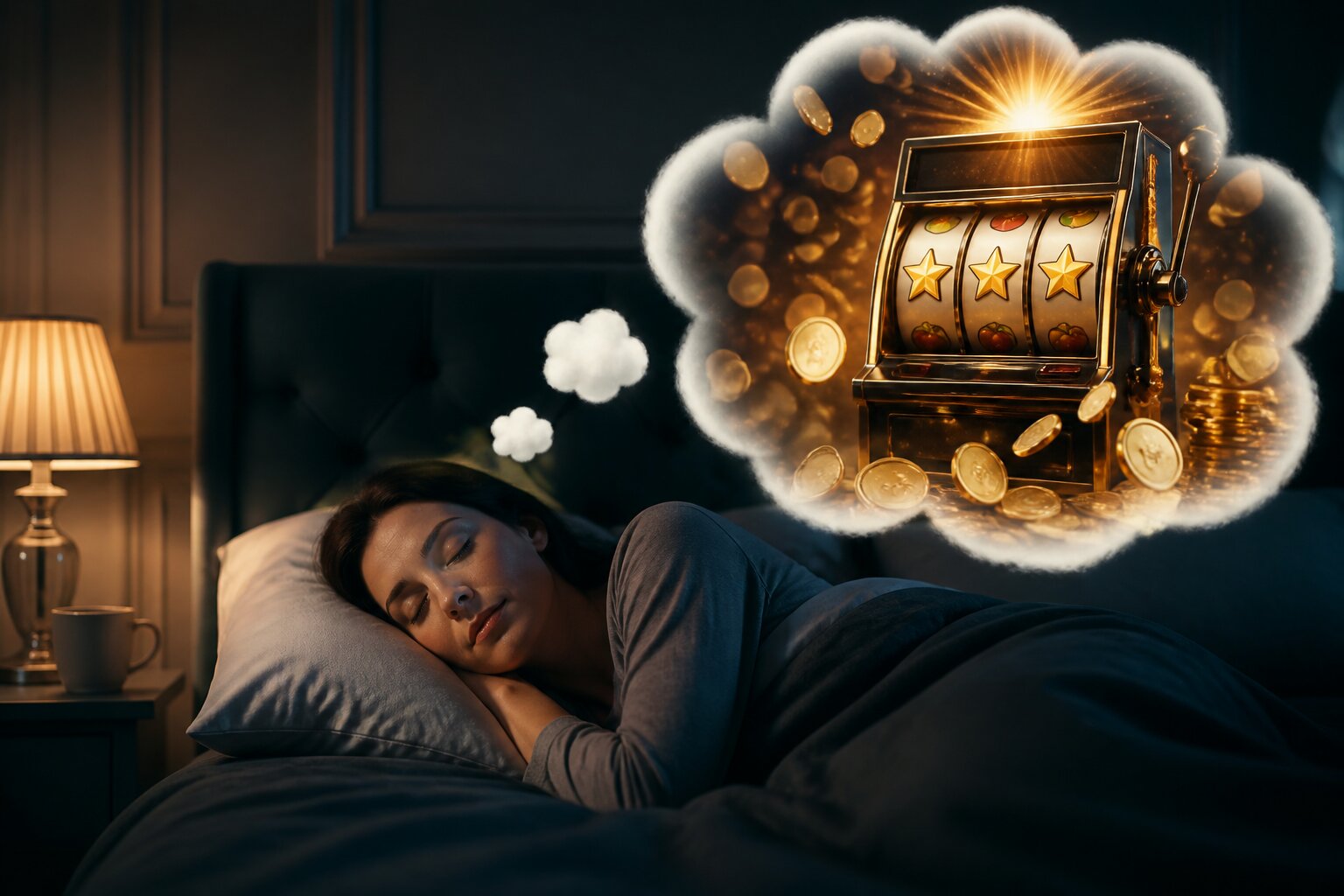
Ever woken from a dream where the reels lined up and coins spilled out? You are far from alone; many people report vivid dreams about slot machines and the thrill of a big win.
Those dreams can stir strong feelings and questions: are they meaningful, a warning, or simply the brain sorting through experiences? This article separates common myths from clearer psychological and cultural explanations to help you understand what such dreams might signify.
Read on as we unpack the most frequent interpretations and correct the misunderstandings that often follow these vivid nocturnal scenes.
What Does Dreaming of Winning on a Slot Machine Mean?
Dreams about winning on a slot machine can represent several different themes depending on personal context. Psychologically, they often mirror hopes for sudden positive change or a desire for recognition after a difficult period. The image of reels stopping on matching symbols can stand for an imagined breakthrough — a moment when things finally click into place.
Emotionally, these dreams frequently surface during transitions or stress. If someone is facing an important decision, a slot-win dream may express the wish for a favourable outcome without spelling out how it will happen. The sensory detail in such dreams — the sound of coins, the visual of a jackpot — can simply amplify existing anticipation or relief.
Culturally, slot machines symbolise randomness and risk in many societies. In dreams, they might therefore reflect feelings about uncertainty: a sense that events are beyond control, or that outcomes hinge on external forces. That symbolic role helps explain why slot-machine imagery recurs at particular moments in life.
These meanings are not mutually exclusive; a single dream can blend desire, anxiety and symbolic commentary on a specific situation. Next we'll look at common misunderstandings that tend to follow these images and how to separate them from more plausible explanations.
Common Misconceptions About Slot Machine Dreams
A number of persistent myths surround dreams of slot-machine wins, and each can lead to poor decisions if taken at face value. One widespread assumption is that such dreams predict real-life outcomes. Scientific evidence does not support the idea that dreams forecast the results of games of chance or other measurable events.
Another misconception is that a dream signals a sign from outside forces to take action, such as gambling more in the hope of repeating the dream’s outcome. Treating dreams this way can encourage unhelpful patterns because it substitutes feeling for reasoned decision-making. Games of chance are governed by randomness and regulation, not by subjective experiences during sleep.
Some people think that vivid dreams are a message to avoid risk, or conversely that they are encouragement to chase a quick win. In truth, the content of a dream is shaped by personal history, emotion and recent thoughts, not by instructions for waking behaviour.
Understanding these common errors helps keep expectations realistic and supports healthier responses to dream imagery. With that clarified, we can explore what psychological theory offers about why these dreams occur.
Psychological Interpretations of Slot Machine Dreams
From a psychological perspective, slot-machine dreams often express internal drives and unresolved emotions. They can symbolise a yearning for reward or recognition, particularly after repeated effort or setbacks. The idea of an instant win condenses a complex wish — for validation, security or sudden change — into a single, dramatic image.
Such dreams may also reflect attitudes toward risk and control. Spinning reels portray outcomes that depend on chance; dreaming of them can indicate feelings that life situations are unpredictable or beyond personal control. For people who feel restricted by routine, these dreams might represent a subconscious desire to experience novelty or to break free from constraints.
Impulsivity and thrill-seeking can appear too: the excitement of pulling a lever in a dream may mirror a waking craving for stimulation. Conversely, if the dream includes anxiety about losing, it can point to worry over decisions and their potential consequences.
Therapeutically, discussing these dreams often yields insight into priorities and fears, as well as practical ways to address them. The psychological lens emphasises that dreams are reflections of internal states rather than forecasts of external events. The next section looks at how cultural stories shape these personal meanings.
Cultural Beliefs and Folklore Surrounding Slot Machine Dreams
Cultural context colours how people interpret slot-machine dreams. In many places, stories and folk teachings link dreams about money or games to forthcoming change; these narratives provide a familiar framework for interpreting otherwise ambiguous experiences. In some communities, such dreams are considered warnings to be cautious with resources, while elsewhere they are framed as symbols of impending opportunity.
Different traditions attach varied emphasis to the same imagery. For example, a dream about reels stopping on certain symbols might be read as an indicator of personal transformation in one culture and a nudge toward prudence in another. These interpretations reflect communal values about risk, wealth and decision-making rather than any universal meaning.
While cultural readings are meaningful within their communities, they do not alter the mechanics of real-world games or provide reliable guidance for behaviour. Appreciating the folklore helps explain why people attach significance to their dreams, and it prepares us to separate cultural symbolism from practical matters discussed next.
Myths Versus Reality: Are Slot Machine Dreams Predictive?
Wishing that a dream foretells events is natural, but the evidence favours a different conclusion. Research into dreaming and memory indicates that dreams are constructed from recent experiences, emotional concerns, and cognitive processes. They do not exert influence over regulated systems or randomised outcomes.
Common myths include beliefs that dreams are omens or that ignoring a dream risks missing an opportunity. Reality-checking those ideas shows they are interpretations rather than facts. Games of chance operate independently of dream imagery; their outcomes are determined by random processes and oversight designed to ensure fairness.
Recognising this distinction helps prevent decisions driven by expectation rather than understanding. If a dream stirs a desire to act — for instance, to play a game — the sensible response is to evaluate the choice on its own merits: consider finances, motivation and possible consequences. The following section explores how those emotional reactions can shape behaviour, for better or worse.
How Dreams About Winning Slots Reflect Personal Emotions
Slot-machine dreams often mirror personal hopes, anxieties and aspirations. The sensation of winning captures the allure of sudden positive change: it can stand in for hopes about a promotion, reconciliation in a relationship, or relief from ongoing pressure. Those emotions can be vivid in dreams because they occupy a prominent place in waking thought.
At the same time, the randomness associated with slot machines can underscore fears. If someone feels that control is slipping in a particular area — work, health or finances — the dream imagery can dramatise that unease. The same symbolic language can therefore express both optimism and apprehension, depending on context.
Examining these emotional contours offers useful insight: understanding what the dream emphasises helps clarify current priorities and stressors. Having seen how emotions tie into dream content, the next part looks at whether and how such dreams might shape actual behaviour.
Can Slot Machine Dreams Influence Real-Life Behaviour?
Dreams can affect mood and attention, sometimes nudging people toward interests they might otherwise dismiss. However, there is no conclusive evidence that dreaming about winning directly causes increased gambling or risk-taking. Behavioural shifts tend to result from a wider mix of factors: personal beliefs, social environment, financial circumstances and existing habits.
When dreams do prompt action, it is often through emotional priming — a vivid dream can heighten curiosity or make a theme more salient for a short time. That influence is psychological rather than predictive; it changes perception, not external outcomes. This distinction matters when deciding how to respond to a dream: assessing motivations and potential consequences leads to clearer, safer choices.
Regulatory guidance and consumer organisations advise that play should be treated as entertainment, with decisions based on practical considerations rather than dreams or folklore. If gambling stops feeling optional or enjoyable, support services and harm-minimisation tools are available to assist individuals in regaining control.
The way someone interprets a dream can be meaningful and revealing. At the same time, grounding actions in clear-headed assessment ensures that choices remain deliberate and informed, bringing this discussion to a close with a clear takeaway.
Play Online Slots at Daisy Slots
We'd be delighted to welcome you to our site, where you can enjoy playing online slots at whatever pace suits you best. Feel free to explore our games in your own time, with no pressure or rush.
Getting started is straightforward—simply create an account, make a deposit and you're ready to play. We look forward to having you with us at Daisy Slots.
**The information provided in this blog is intended for educational purposes and should not be construed as betting advice or a guarantee of success. Always gamble responsibly.