
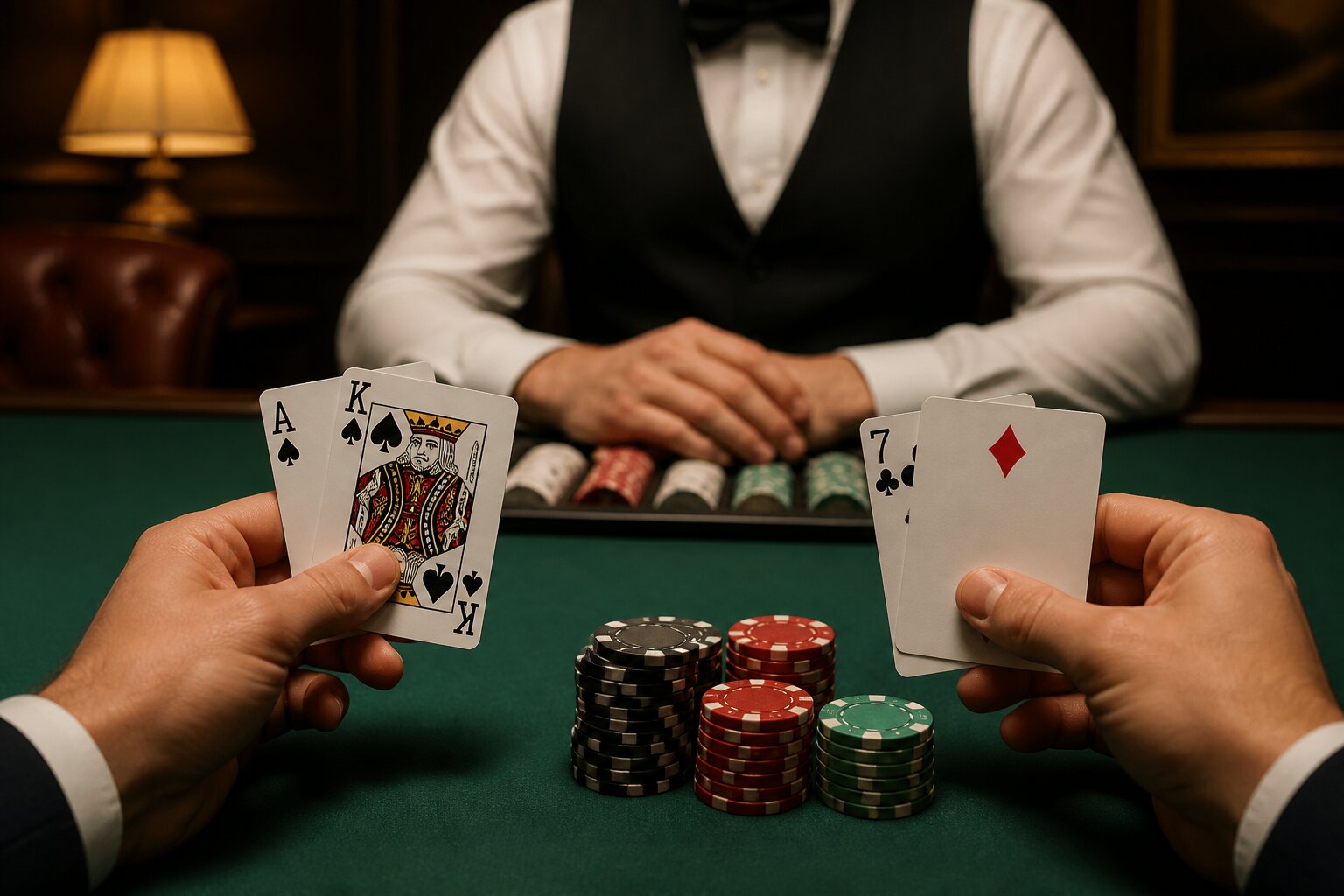
Ever wondered why some blackjack hands make you feel like a winner before the dealer has even flipped their card, while others leave you hoping for a miracle?
Knowing which hands give you the best shot — and which are troublemakers — changes how you approach each round. Whether you’re new to the table or refining your play, a clear sense of hand rankings helps you make calmer, smarter choices.
Read on to see which hands deserve a fist pump and which ones demand caution — and learn how that knowledge guides your next move.
Understanding the Basics: What Makes a Blackjack Hand?
Blackjack hands are built from the values of the cards you’re dealt. Number cards count at face value, face cards (jack, queen, king) count as ten, and an ace can count as either one or eleven, whichever benefits the hand without pushing it over 21. Each player starts with two cards and the goal is to approach 21 as closely as possible without exceeding it. If the total goes over 21 the hand busts and is lost.
A two-card 21 that comes from an ace plus any ten-value card is a special case called a “blackjack” — it’s treated differently from 21 made with three or more cards because of how it compares in play and in payout. Other totals are simply measured by how close they are to 21; a 20 beats a 19, a 19 beats an 18, and so on.
Consider a few short examples to make this concrete: a 7 and a 5 make 12; add an ace and that ace becomes 11 only if it keeps the total at or below 21, otherwise it counts as 1. With this foundation in place, you can start to see why certain hands are ranked above others — next we’ll look at the ranking itself and what those positions mean for decision-making.
How Are Blackjack Hands Ranked?
Hands are ranked strictly by their total value up to 21, with two-card blackjacks occupying a special top position. A natural blackjack typically outperforms any 21 made with more cards and often carries a better payout. Below that, two-card totals close to 21 — like 20 or 19 — are strong because they give the player little incentive to risk drawing another card.
Rankings are not only about totals but also about composition and options. A pair of aces, for instance, is valuable not only because of its potential total but because it can be split to form two new hands with strong prospects. Conversely, a hard total (one without an ace counted as 11) can be harder to improve safely.
The dealer’s upcard also affects how a given ranking performs in practice: a player’s 16 against a weak dealer’s upcard will play differently from that same 16 facing a dealer ten. Understanding ranking helps frame these choices, which leads naturally into a closer look at the very best hands and why they matter.
The Best Hands in Blackjack
Top hands in blackjack are those that either win outright or place you in a comfortable, low-risk position. The highest possible outcome is a natural blackjack, followed by very high totals like two-card 20s. These hands reduce uncertainty and simplify decision-making, giving you practical control over the round’s direction.
Natural Blackjack: The Ultimate Hand
A natural blackjack occurs when the first two cards are an ace and any ten-value card (10, jack, queen or king). This two-card 21 typically beats hands of the same total made with more cards and is usually rewarded with a superior payout, reflecting its strength.
Ace + 10
Ace + Jack
Ace + Queen
Ace + King
Because this combination stands apart from ordinary totals, it influences how both players and dealers settle the round. With that top-of-the-deck outcome explained, it’s worth turning to other very strong hands and why they still matter.
Other Strong Hands Worth Noting
A two-card 20 is the next-best ordinary hand and often makes standing the obvious choice; it will only be beaten by a blackjack. Totals of 19 and 18 are also strong in most situations, especially when the dealer shows a weak upcard, because they leave little incentive to risk drawing more.
High-value pairs, such as a pair of aces, have strategic value beyond their immediate total. Splitting aces gives two chances to hit 21; splitting tens is almost always discouraged because a 20 is already so powerful. These considerations show that a hand’s usefulness is about both current strength and future options — and that understanding leads into which hands you should treat with more caution.
The Worst Blackjack Hands Explained
Certain hands put players in awkward spots where neither hitting nor standing feels comfortable. These are typically mid-to-high hard totals that are close enough to 21 that a hit carries significant bust risk, yet low enough that standing often leaves you liable to lose.
Least Desirable Starting Combinations
A hard 16 is widely regarded as one of the worst positions, especially when made of a ten and a six. Hitting risks busting on many of the cards that can be drawn, while standing against a strong dealer upcard is usually insufficient to win. Hard 12 is also tricky: it sits in a zone where drawing a ten-value card is a frequent outcome, yet standing can be risky depending on the dealer’s showing.
The problem with these hands is their limited upside. They’re neither strong enough to demand a stand in many situations nor safe enough to encourage a hit without a high bust probability. This nuance matters when comparing them to hands with clearer strategic paths, which we’ll examine next.
Common Problem Hands & Pitfalls
Totals of 13, 14 and 15 share similar problems: they are vulnerable to ten-value cards and often leave the player in a marginal spot against a dealer’s strong upcard. Low pairs, like two fours or two fives, can tempt players to split or hit in ways that worsen their position if done without careful thought.
These scenarios call for calm analysis rather than emotion. The way a hand is played — considering its composition and the dealer’s visible card — often determines whether a difficult total becomes a recoverable situation or a lost opportunity. With that in mind, the next section explains why certain hands carry greater practical weight than others.
Why Do Certain Hands Matter More Than Others?
Hands matter because they change the balance of options available and the level of risk a player faces. A strong total like 20 simplifies the choice: standing preserves a near-optimal position. Weaker hands impose trade-offs that force players to weigh the chance of improvement against the risk of busting.
This is also where composition comes into play. A hand with an ace gives flexibility because the ace can be counted as 1 or 11, altering the risk profile of taking another card. Pairs change the decision set as well, since splitting can convert one mediocre hand into two viable ones. The dealer’s upcard is the final piece of the puzzle, shaping whether a conservative or aggressive approach is likely to pay off.
Understanding these dynamics helps make sense of why some hands feel decisive while others feel precarious, and it naturally leads into how that knowledge can guide table decisions.
Can Hand Rankings Influence Your Table Decisions?
Hand rankings give a framework for choosing the most sensible option in any situation. Knowing that 20 is a highly favourable total discourages risky play, while recognising the weakness of a hard 16 explains why more aggressive or unconventional choices are sometimes taken by experienced players.
Rankings also affect choices about splitting and doubling. A pair of eights, for example, is typically split because two new hands starting from eight each often perform better than a single 16. A total of 11 can make doubling down attractive because the chance of improving to a very strong total is comparatively high. These are strategic tendencies rather than guarantees, and they are best used alongside established basic strategy and sensible bankroll management.
Keeping play within personal limits and using strategy to inform decisions helps maintain the game’s entertainment value. Apply these principles and you’ll find each hand’s ranking becomes a practical tool for clearer, more confident table play.
Play Online Casino Games at Daisy Slots
We invite you to experience the relaxed enjoyment of playing casino games with us at Daisy Slots. Take your time and explore our site in a welcoming atmosphere designed for your entertainment.
**The information provided in this blog is intended for educational purposes and should not be construed as betting advice or a guarantee of success. Always gamble responsibly.