
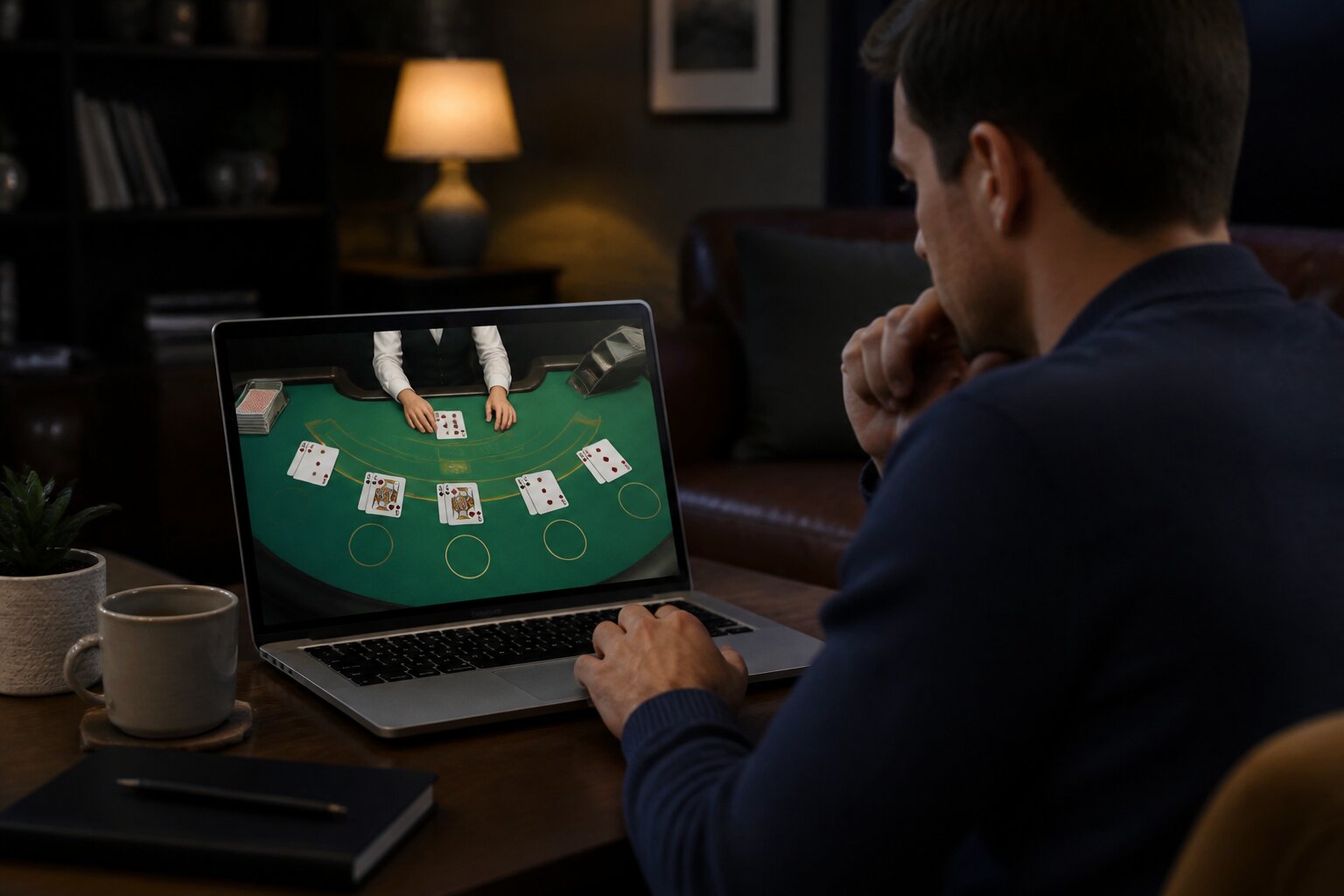
You’re at an online blackjack table: you’ve been dealt blackjack and the dealer’s upcard is an ace. The game pauses and an “even money” option appears, offering a straight 1:1 payout immediately. It’s tempting — a guaranteed outcome when the alternative could be a push.
That instant decision feels important, but a quick choice isn’t always the best one. This article breaks down what even money actually means, how it compares to insurance, the likely long-term effect on your returns, and the situations where a player might reasonably accept it. Read on to make more confident decisions when the option comes up.
What Does Even Money Mean in Blackjack?
Even money is a single option that becomes available only when you have a blackjack (an ace plus a ten-value card) and the dealer’s upcard is an ace. Accepting it converts the typical blackjack payout into an immediate 1:1 win: a £10 stake returns a £10 profit straight away, instead of the usual 3:2.
Normally, blackjack pays 3:2, so a £10 winning hand would yield £15. If the dealer also has blackjack, though, the normal result is a push and your stake is returned. Accepting even money eliminates that uncertainty by guaranteeing the smaller payout regardless of the dealer’s hole card.
Think of even money as a one-off settlement option for that precise scenario: it settles the main wager instantly at a lower rate than the full blackjack payout. If you want to know why casinos present this choice and how it affects your expected returns, the next section explains the business logic and the statistical picture behind the offer.
Why Do Online Casinos Offer Even Money?
Casinos present even money as a convenience: it’s an alternative for players who prefer certainty in that specific situation. From the operator’s point of view, it’s a simple way to let players avoid a push at the cost of a smaller payout.
Statistically, because the dealer will not have blackjack more often than they will, offering even money shifts some value away from the player back to the house over many hands. For the player, taking the option trades the chance of the higher 3:2 payout for a guaranteed 1:1 return. The prompt appears before the dealer checks the hole card so the decision is made without knowing the outcome, which is why understanding the numbers matters.
Knowing why the option exists helps when weighing it against your own priorities — whether you prefer a steadier session or want to maximise long-term return. The following section explores the concrete advantages and drawbacks to help you decide.
Pros & Cons of Taking Even Money Online
The decision to accept even money is a balance between certainty and value. Below, the benefits and downsides are explained with examples so you can see how the choice plays out over time.
Possible Advantages of Accepting Even Money
Accepting even money provides an immediate, guaranteed win. For some players this is appealing when they want to lock in a positive result without waiting to see if the dealer also has blackjack. It can reduce the emotional sting of a push, and for someone on a tight session budget or approaching a personal limit, an assured outcome can help manage exposure.
The option can also be useful late in a session when preserving a modest profit matters more than seeking the higher payout. In those circumstances the smaller, guaranteed return may fit a player’s risk tolerance and short-term goals.
Drawbacks & Missed Opportunities
The primary downside is financial: over time, taking even money lowers expected returns compared with refusing it. When you decline even money and the dealer does not have blackjack, a 3:2 payout produces a larger win — for example a £10 bet returns £15 rather than £10. Because the dealer lacks blackjack more often than not, consistently accepting even money sacrifices value.
Frequent acceptance of even money reduces potential earnings across multiple hands. If your objective is to maximise the mathematical return from blackjack, refusing even money is generally the better choice. If your priority is a guaranteed result for a particular hand or session, accepting it can sometimes make sense.
If you want a clear idea of how outcomes are resolved when you decline the offer, the next section explains the mechanics and likely results.
Should You Ever Take Even Money at Online Blackjack?
Most players aiming for the strongest long-term return decline even money. With the dealer’s upcard an ace, the probability that the dealer also has blackjack is around 31%, meaning roughly 69% of the time the dealer will not have blackjack and the full 3:2 payout applies to your hand. That statistical balance is why refusing even money tends to be the mathematically preferable route.
Nevertheless, personal circumstances affect the decision. Players who prize certainty, are protecting a capped bankroll, or are choosing to end a session with a definite gain may reasonably accept even money in specific hands. It’s a matter of personal preference rather than a universal right or wrong: weigh what you prefer in the moment and how it fits with your session objectives.
For a precise picture of how payouts differ when you refuse even money, the following section sets out the possible outcomes and sample returns.
Difference Between Even Money & Insurance
Even money and insurance are related but distinct offers that appear when the dealer shows an ace.
Even money is available only when you already have blackjack; accepting it settles your main wager at 1:1 right away. Insurance, by contrast, is a separate side bet open to any player when the dealer’s upcard is an ace. Insurance covers the specific risk of the dealer having blackjack: you may wager up to half your original stake on the dealer holding a ten-value downcard, and that insurance pays 2:1 if it wins.
The practical differences are:
- Even money resolves the main hand immediately for a player with blackjack.
- Insurance is an optional side bet for any player that compensates if the dealer’s hole card completes a blackjack.
Because they address the same visible risk from different angles, understanding both helps you make an informed choice when the ace is showing. The next section explains the outcomes you’ll see at the table if you refuse the even money offer.
How Do Payouts Work If You Refuse Even Money?
When you decline even money, the dealer checks their face-down card and the hand is resolved according to standard rules.
There are two possible outcomes:
- If the dealer has blackjack, the result is a push: your original stake is returned and there’s no win or loss on that hand.
- If the dealer does not have blackjack, your blackjack pays 3:2. For a £10 stake that means £15 winnings plus your returned stake.
Because the dealer will not have blackjack roughly 69% of the time, declining even money is more likely to yield the higher payout. That mathematical tendency explains why most players seeking the best expected return choose to refuse the 1:1 offer and accept occasional pushes instead.
Be mindful of your own budget and play with limits that suit you; choosing between the certainty of even money and the larger, less frequent payoff is a personal decision that should fit your session plan.
Always play responsibly, stick to the limits you set, and let your objectives for a session guide whether you accept even money or not.
Explore Casino Games at Daisy Slots
We welcome you to discover the range of casino games waiting for you at Daisy Slots. With so many different ways to play, there is always something to suit your style and taste.
Getting started could not be simpler: just create an account, make a deposit and you will be ready to enjoy our games. We look forward to seeing you at the tables.
**The information provided in this blog is intended for educational purposes and should not be construed as betting advice or a guarantee of success. Always gamble responsibly.