
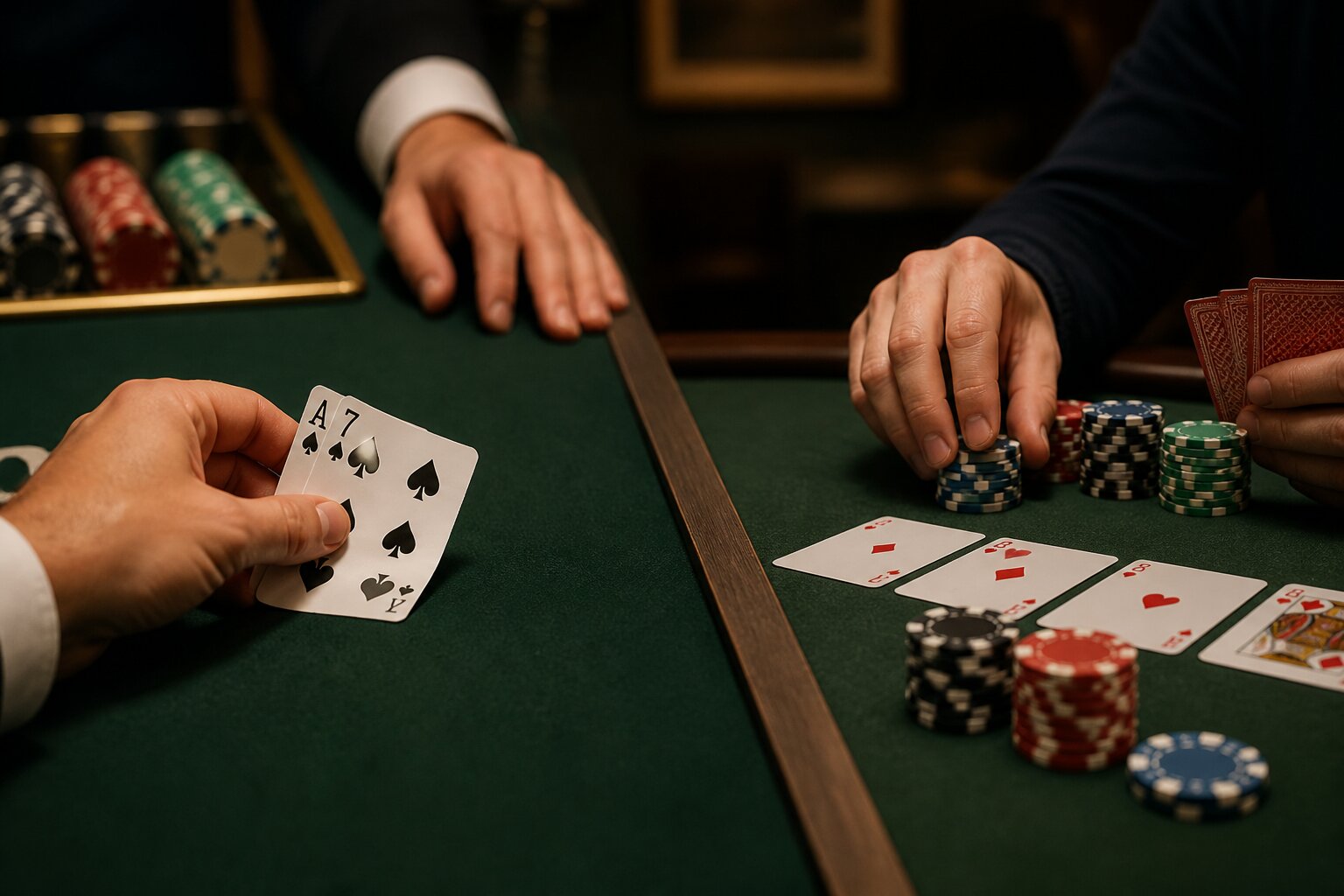
Ever wondered if blackjack and poker are just two names for the same card game? You’re not alone—many people mix them up, especially when they’re new to casino games.
Both games use playing cards and require strategy, but they are organised and played very differently. Read on to see what sets them apart and why those differences matter when you’re choosing a table.
Ready to clear up the confusion? The next sections break down rules, play style and what each game asks of you so you can tell them apart with confidence.
Core Rules: Blackjack vs Poker
Blackjack is played against the dealer. Each player receives two cards and aims for a total value closest to 21 without exceeding it. Players decide whether to ‘hit’ for another card or ‘stand’ to keep their total, and there are options such as ‘double down’ or ‘split’ when the initial cards allow. Face cards count as 10 and aces can be worth 1 or 11. At the end of the round the dealer reveals their hand and compares outcomes with each player.
Poker is normally played against other players. In Texas Hold’em, a common form, each player receives two private cards and can combine these with five shared community cards to make the best five-card hand. The game revolves around rounds of betting, the possibility of bluffing, and the strategic decision to fold, call or raise. The winner is the player with the highest-ranking hand at showdown, or the last player left after everyone else folds.
These core rule differences — who you play against, how hands are resolved, and the role of betting — give each game its distinct feel. Next, we’ll look at how a typical session unfolds in each game to show those differences in action.
How Are Blackjack And Poker Played?
Blackjack begins with every player placing a stake for the upcoming hand. The dealer deals two cards to each player and two to themselves, usually with one dealer card face down. Players take turns choosing whether to take further cards or to stop, and special moves like doubling or splitting change bet size and hand structure. When the dealer finishes drawing cards according to house rules, comparisons are made and payouts follow.
A poker round, such as Texas Hold’em, has a sequence of betting intervals that shape the hand. It starts with mandatory bets from certain players, followed by the deal of private cards. Community cards are revealed over subsequent stages — the flop, the turn and the river — with betting rounds between them. Players decide how much to commit at each stage, and hands are resolved either when all but one player folds or at a showdown where the best hand wins the pot.
The tempo differs, too: blackjack rounds tend to be quick and discrete, while poker sessions unfold over many interlocking betting rounds that reward longer-term strategic thinking.
Comparing Decks, Players & Tables
Both games usually use a standard 52-card deck, but blackjack often uses multiple decks shuffled together to suit the venue’s rules, while poker is usually played with a single deck per table. Blackjack tables typically seat up to seven players facing a dealer, with each player’s result independent of others. Poker tables are arranged so players face one another and may seat up to ten players, depending on the variant.
Table layout and dealer interaction affect player behaviour. In blackjack you focus on your hand versus the dealer’s, with the dealer following a fixed drawing routine. In poker you watch opponents for betting patterns and body language because every opponent’s choice directly affects the pot.
These physical and structural differences shape how you approach each game, from where you sit to how you read the action at the table.
What Are The Main Objectives Of Each Game?
In blackjack the objective is straightforward: finish a hand with a total closer to 21 than the dealer without going over. Busting — exceeding 21 — ends the hand instantly and results in a loss for that round. Success is measured against the dealer’s hand on a hand-by-hand basis.
Poker’s objective is to win the pot, which is the total of bets placed during the hand. Victory comes either by showing the best five-card hand at showdown or by persuading all other players to fold so you collect the pot uncontested. Because betting can change the pot size and opponent behaviour, the strategic aim encompasses both card strength and how you manage those betting opportunities.
These distinct aims mean the tactics you use in each game look and feel different; one is mainly about beating a predictable dealer routine, the other about outplaying people across several betting phases.
House vs Player: Who Are You Playing Against?
Blackjack pits each player directly against the house, represented by the dealer. Every player’s outcome depends on how their hand compares with the dealer’s, and one player’s win doesn’t affect another’s result for that same hand.
In poker the opposition is the other players at the table. While a dealer may be present to manage the game, they do not compete. Your success depends on reading opponent tendencies, managing your chip stack and choosing when to contest the pot.
This difference influences mindset: blackjack rewards precise, rule-based choices, whereas poker emphasises reading people and adapting strategy to opponents’ behaviour.
Popular Variants: Which Games Exist Within Blackjack And Poker?
Blackjack has a number of variants that tweak dealer rules, payout structures or available player options. Versions include Classic Blackjack, European Blackjack (which changes when the dealer receives cards), Pontoon (with different terminology and payouts) and Blackjack Switch (allowing card swaps between hands). These variations change the mathematical edge and the decisions you face at the table.
Poker contains many widely played forms. Texas Hold’em features private and shared cards and is the dominant tournament game. Omaha also uses shared cards but requires different hand-building rules. Seven Card Stud distributes a mix of face-up and face-down cards without community cards, and Five Card Draw permits exchanging cards. Each variation has its own strategic focus and pacing.
If you like variety, both games offer rule sets that keep play interesting while altering risk and reward in predictable ways.
Are Betting Systems Different in Blackjack and Poker?
Betting in blackjack is typically a single wager placed before the hand begins, with occasional options to increase that stake through doubling or splitting under certain conditions. Payouts for wins are usually fixed by the rules in advance.
Poker betting unfolds over multiple rounds, with players choosing to fold, call or raise as community cards are revealed. The pot grows and can become substantially larger than any single initial stake, making individual decisions more consequential as the hand progresses.
No betting system can guarantee success. Approaches to bet sizing and bankroll management should be realistic and focused on maintaining control rather than chasing specific outcomes.
Transitioning from how bets are handled leads naturally to the skills each game demands, which differ because of these betting structures.
Do Blackjack And Poker Require Different Skills?
Blackjack rewards quick, disciplined decision-making and a solid understanding of the game’s basic strategy — a set of mathematically derived choices about when to hit, stand, split or double. Players who learn these guidelines reduce the house advantage and make more consistent choices under pressure.
Poker requires a broader skill set: numerical reasoning about pot odds and hand equity, an ability to interpret opponents’ patterns and an understanding of position and bet sizing. Psychological insight and timing matter because the interplay between betting rounds and player reads often determines the outcome, not just the cards.
Both games reward study and practice, but the emphasis shifts from rule-based optimisation in blackjack to opponent-focused strategy in poker.
Common Misconceptions: Is Blackjack Considered A Poker Game?
It is common for newcomers to lump blackjack and poker together because they both use playing cards and are often found side by side in casinos. Superficially they can look similar, but they belong to different families of card games with different aims and dynamics.
At its core, blackjack is a single-player-versus-house game in which the aim is to reach a target total without going over. Poker, by contrast, is a competitive contest between players where betting, reading opponents and bluffing are central to success.
These differences mean you will encounter different strategies, table atmospheres and skills depending on which game you pick. Typical contrasts include:
- Opponents: in blackjack you play against the dealer or house; in poker you play against the other players.
- Objective: blackjack focuses on achieving a numerical total; poker focuses on forming hands and using betting to win pots.
- Skillset: blackjack rewards probability-based decision making and bankroll management; poker rewards psychological skills, long-term strategy and the ability to adjust to opponents.
- Pace and social tone: blackjack tends to be faster and more procedural; poker is often slower, more conversational and more strategic over multiple hands.
Recognising these distinctions will help you choose the game that best fits your preferences and the skills you want to develop. Remember to play responsibly and treat both games as entertainment rather than guaranteed income.
Which Game Is Best For Beginners?
Choosing a first game depends on what you want from the experience. Blackjack tends to have simpler, faster rounds and a clear set of strategic rules people can learn quickly, making it a common starting point for newcomers. Poker offers deeper long-term strategic reward because decisions in successive betting rounds and the social element of reading opponents create more variables to master.
Think about whether you prefer a game of concise, rule-driven choices or a game that combines card knowledge with interpersonal strategy. Either way, approach play with limits in mind and treat outcomes as part of a single session rather than a guaranteed return.
Play responsibly and set time and money boundaries that suit you. If you ever feel your gambling is becoming difficult to manage, support services are available in the UK to offer advice and help.
This should give you a clear picture of how blackjack and poker differ and what to expect from each — so you can pick the one that fits your style or enjoy both for different reasons.
**The information provided in this blog is intended for educational purposes and should not be construed as betting advice or a guarantee of success. Always gamble responsibly.