
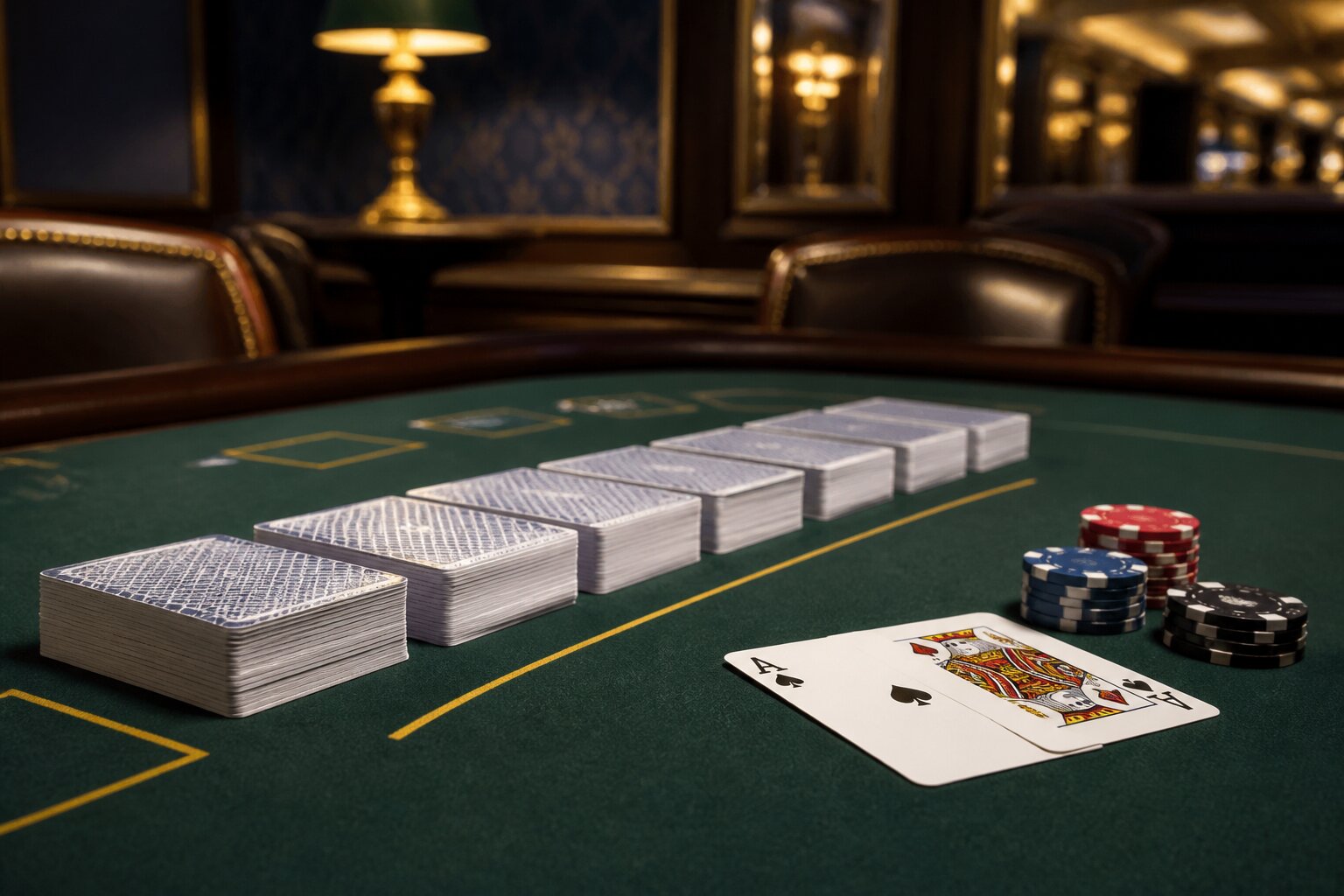
Ever sat down at a blackjack table and wondered if it really makes a difference whether there’s one deck in play, or six? You’re not alone; plenty of keen players have had the same thought, especially after noticing how often the number of decks changes between tables and online games.
At first glance, it might all look pretty similar—a quick shuffle, a few crisp cards, and the same aim of beating the dealer’s hand. But beneath the surface, the number of decks can quietly influence everything from the odds on your next card to the overall return you might expect across a night’s play.
So, next time you’re choosing where to have a flutter, just how much should you be bothered about the stack of cards being shuffled? The following sections unpack the practical differences and what they mean for your play.
How Many Decks Are Used in Different Versions of Blackjack?
Blackjack comes in several versions, and the number of decks used can change quite a bit depending on where and how you play. The classic version some players picture uses a single deck of 52 cards, but these games are far less common nowadays, especially online.
Double-deck blackjack, where two decks are mixed together, appears from time to time—mainly in specific online tables or at certain venues aiming to attract experienced players. These games are usually labelled as “single-deck” or “double-deck” so players know what to expect.
Most standard blackjack tables use six decks shuffled together. Some variants use eight decks to make card-tracking more difficult and to suit busier tables where more players join each round. Casinos and game interfaces normally make the deck count clear in the rules or on the table so you can check before you play.
Knowing the deck count matters because it changes the probabilities you face at the table, and that leads naturally into why casinos prefer multi-deck games.
Why Do Casinos Use More Than One Deck?
Casinos introduced multiple decks into blackjack for a few practical reasons that affect how the game runs and how easy it is to follow the cards.
One main reason is to make card counting harder. With a single deck, skilled players can more easily track which cards have been dealt. Adding more decks reduces the impact of each individual card and complicates any attempt to keep an accurate running count. Casinos also reduce interruptions in play by using several decks, so there’s less frequent reshuffling and the game keeps moving at a steady pace.
Using several decks also allows more players to be dealt into a round without running out of cards, which keeps tables full and play efficient. These operational benefits are why multi-deck formats are now the norm in many venues and online tables. Next, we’ll look at how those different deck counts change the player’s odds at the table.
How Deck Number Influences Player Odds
The number of decks in blackjack affects the underlying probabilities of various hands and therefore the house edge. Fewer decks generally give the player slightly better odds, while each additional deck nudges the mathematics in the house’s favour.
For instance, a single-deck game offers a higher chance of being dealt a natural blackjack (an Ace with a 10-value card) than a multi-deck game, because there are fewer total cards diluting those combinations. As decks increase, that probability falls and the house edge rises. Typical figures under standard rules show a house edge around 0.17% for single-deck play, roughly 0.46% for two decks, and about 0.64% for six decks, with eight decks slightly higher still.
Those differences may look small hand by hand, but over many deals they influence long-term returns and the difficulty of gaining any statistical advantage. With that in mind, the next section explains what those deck changes mean for card counting and practical play.
Impact on Card Counting and House Edge
More decks make card counting far less practical. In a single-deck game, after only a few hands a player can form a reasonably clear estimate of the remaining balance of high and low cards. Add several decks, and the influence of any single card is much smaller, so counting systems become less precise.
Casinos also use techniques such as more frequent shuffles or automatic shufflers to further limit the usefulness of counting. As the deck count increases, the house edge rises too, so even disciplined strategy yields smaller margins of improvement in multi-deck formats.
Casinos are within their rights to refuse play to anyone suspected of advantage play, and players should always be aware of the venue’s rules and policies. With the practical limits on counting in mind, it’s worth examining some common misunderstandings about deck numbers next.
Common Myths About Deck Numbers in Blackjack
Lots of beliefs circulate about decks and advantage play. Separating fact from fiction helps you choose a table with clear expectations and avoid decisions based on misinformation.
Does Deck Number Affect Game Fairness?
Some think that more decks make a game less fair or that single-deck games are somehow easier to rig. In reality, licensed operators must meet strict standards and oversight that ensure games are random and dealt according to the stated rules. Independent testing and regular audits are typical requirements, so the number of decks does not change the basic fairness of a properly regulated game.
What deck number does change is the mathematics of the game. Probabilities shift slightly as you increase or decrease the number of decks, which can influence the house edge and certain strategies. Those changes are about odds and strategy, not about whether the game is conducted honestly.
Can You Beat the Casino by Picking Single-Deck Games?
It’s often said that single-deck tables are a sure way to beat the house. While single-deck games can offer a slightly lower house edge under standard rules, operators commonly adjust other rules to compensate. Adjustments such as reduced payouts for naturals, restrictions on doubling and splitting, or different dealer stand rules can offset the advantage from fewer decks.
Because of these compensating rule changes, single-deck play is not a guaranteed path to beating the casino. Skilled play and good bankroll management can improve your results, but no choice of deck number removes the inherent house advantage in regulated play. With these misconceptions cleared up, consider what matters most when choosing a table: the full set of rules, the payout structure, and how comfortable you are with the betting limits and pace of play.
Deck Choice: What Should Players Consider?
Picking a blackjack table is about more than deck count. Rule variations, payouts and the pace of play are equally important when assessing where you’ll get the best value and the most enjoyment.
Check the payout for a natural blackjack, doubling and splitting rules, and any restrictions on surrender. These factors often change the effective house edge more than deck number alone. Also think about the table’s pace and how many other players are typically seated; multi-deck games let more people play each round, while single-deck tables usually move faster and feel more traditional.
Set clear personal limits before you play and stick to them. Responsible play tools such as deposit limits and self-exclusion are commonly offered and can help you manage your play. Ultimately, choose the combination of rules and deck format that matches your priorities—whether that’s the small statistical edges of particular rule sets or simply a style of game you enjoy.
That choice brings the discussion full circle: deck number matters, but it’s one part of a wider set of rules and conditions that together determine how blackjack plays out for you.
Play Casino Games Online at Daisy Slots
We invite you to experience the fun and entertainment of playing casino games with us at Daisy Slots. Discover the enjoyment on offer as part of our welcoming community.
Getting set up is hassle-free: simply create an account, make a deposit and you are ready to explore all we have for you. We look forward to seeing you enjoy your time with us.
**The information provided in this blog is intended for educational purposes and should not be construed as betting advice or a guarantee of success. Always gamble responsibly.